

There is something about an organized photo walk that completely changes how I see Paris. Guided by a professional photographer and a small group of six photo enthusiasts, we were given a specific mission: look for lines, angles, movement, and vivid contrast. My brain immediately switched into high gear.
As we wound through familiar spots—Place du Tertre, Sacré-Cœur, and Dalida’s statue—I stopped focusing solely on the any monuments, except the ever-present Sacré-Cœur, and turned my lens toward the people. I met Danielle and the dog, Sam; girls with fans; observed children’s behavior and was sure I attracted a crowd while framing a windmill.
The Route: Place des Abbesses
Our walk began at Place des Abbesses, a square bustling with human energy and color and a classically Parisian moment—a man leaning casually out his window for a cigarette break.


Moving to the Medieval Garden & Passage des Abbesses
Within just a few steps of Hector Guimard’s iconic Art Nouveau metro entrance, is the famous I Love You Wall (“Le Mur des Je t’aime“) in the Jehan Rictus Square. (All French pages I cite in this story can be translated into English.)
The Mur je t’aime” wall was the idea of Frédéric Baron, a Montmartre pianist in 1990. Working with the calligrapher, Claire Kito, the wall was inaugurated in 2000. In 612 lava tiles, the phrase “I love you” is written 311 times in 250 languages.

The Civic and Religious Conservation Department for the City of Paris (COARC) is doing the restauration work, which began in 2024.To capture the original colors, they need to clean off the grime, tags, graffiti and stickers; redo the grouting; repair tiles with cracks and damaged writing. It is also an opportunity to correct spelling mistakes. No date has been given for the repairs to finish.
Moving to the Medieval Garden & Passage des Abbesses
Just steps away from the well-documented wall, the crowds suddenly evaporated as we made our way through an archway into the serene Jardin des Abbesses. Established on the historic grounds of the 12th-century royal abbey founded by Louis VI (Louis the Fat) for his wife, Adélaïde de Savoie, this quiet space offers a peaceful sanctuary in a Medieval-style medicinal garden.


While most photographers flock to the famous tree stump in the garden, my eye was drawn to a quieter scene: a man lost in a book who then closed his eyes behind the trees, perfectly sheltered by the canopy.
The Deep Blue Arch (Passage des Abbesses)
Leaving the garden, we stepped into the Passage des Abbesses through its prominent archway. If you walked through before 2023, you’ll notice a striking change: the once muted, off-white passage has been repainted a deep, rich blue as part of standard city garden maintenance (2023-2024). Adorning the inner curve of the arch are handwritten lyrics—”AVANCER SANS VOIR AVEC LE CŒUR OUVERT…” (“Move forward without seeing, with an open heart…”)—from the 2020 song “Sans voir” by the late French rapper Népal.

As we walked down the passage, two lovers hugging against a wall made me think it was a scene from a Robert Doisneau photograph. Passing this “live” street art, we continued into an exhibition of numerous street artists, including M. Chat. Emerging onto rue des Abbesses, a vintage motorcycle sidecar was coming my way, I thought it was part of a movie set.


Walking Toward Place Émile Goudeau
Moving onward to Place Émile Goudeau, the famous Le Bateau-Lavoir sat nearby, but my focus shifted immediately to the human life around the Wallace Fountain. There, I met Danielle and a friendly dog named Sam. I sat down on a bench for a brief chat: Danielle lives right in the neighborhood, while Sam belongs to her neighbor. Taking him on his daily strolls, she explained, brings a nice, happy routine to her day.


Lights on Façades, Rue de la Mire & The Motorcycle Sidecar
Making our way up rue de la Mire toward Place Jean-Baptiste Clément—named for the 1871 Paris Commune hero who penned (in 1866) the famous lyrics to “Le Temps des Cerises”– a vintage motorcycle and sidecar parked at the corner caught my eye. I recognized it from an earlier sighting on rue des Abbesses. It belongs to a local tour company, and at that moment, a family was putting on their helmets to play out their own scenario for a classic film.


Le Moulin de la Galette on Rue Lepic
Turning onto rue Lepic, we hit the ideal vantage point for playing with light, sharp architectural angles, and the famous windmill, Le Moulin de la Galette. As I brought my camera to my eye to compose the shot looking down the hill, I felt a sudden shift around me—a small crowd of tourists had gathered, pulling out their phones to copy my angle! When I turned around to photograph our group standing behind them, two guys assumed my lens was pointed their way and broke into huge poses. Naturally, I couldn’t resist snapping their picture.


Place Marcel Aymé & Women with Fans

Our walk continued along rue Girardon to the Place Marcel Aymé, famous for Jean Marais’s 1989 “Le Passe-Muraille” sculpture of a man emerging from the wall.
Near the entrance to the plaza, a lively scene unfolded: a group of young women were fanning another in their group wearing a vibrant red patterned dress and without fan. Curious, I walked over to ask about the scene—it turned out to be a bachelorette party excursion! With their willingness, I captured a few photos of their colorful fans in motion.
Observation of the liveliness in the plaza continued: people posing in front of the sculpture or for selfies and children listening to someone tell them about Le Passe-Muraille story, which takes place in Montmartre. The apartment building on the plaza bears a plaque where the author of “The Man Who Walked Through Walls”, Marcel Aymé, lived between 1902 and 1967.


The Search for Leaf Shadows on Walls
Years ago, during an internship at the Miami News, one of the photojournalists with whom I worked captured an image of a girl against a house speckled with leaf shadows—a visual image that has stayed with me ever since. I’m always searching the world for that combination of light and foliage.
Walking along rue Girardon, I finally spotted those shadows sprinkled against the stone wall. Just as I adjusted my focus for a second shot, a woman in a polka-dot dress walked into my frame—not quite the memory I was chasing, but a serendipitous moment all the same.


Place Dalida & Rue de l’Abreuvoir
Continuing down rue Girardon brought us to Place Dalida, home to the bronze bust of singer Iolanda Cristina Gigliotti (Dalida). As legend goes, rubbing the statue brings good luck.
A group of children were fascinated. The boys could not resist to either look, touch or photograph the moment. Beyond the local lore, this spot offers one of the finest perspectives in Montmartre: looking down the curvy rue de l’Abreuvoir toward Sacré-Cœur.


Ways to Cool Off: Rue Saint-Rustique & Place du Tertre
We ducked down the narrow rue Saint-Rustique, where restaurant tables stood quietly beneath tree shade with Sacré-Cœur towering nearby. Entering Place du Tertre, the May heat was in full effect. A restaurant worker was cooling off the cobblestones with a hose—and occasionally delighting (or surprising!) passersby with a gentle spray of water. Nearby under shaded parasols, portrait artists chalked sitters with intense concentration, surrounded by fascinated onlookers.


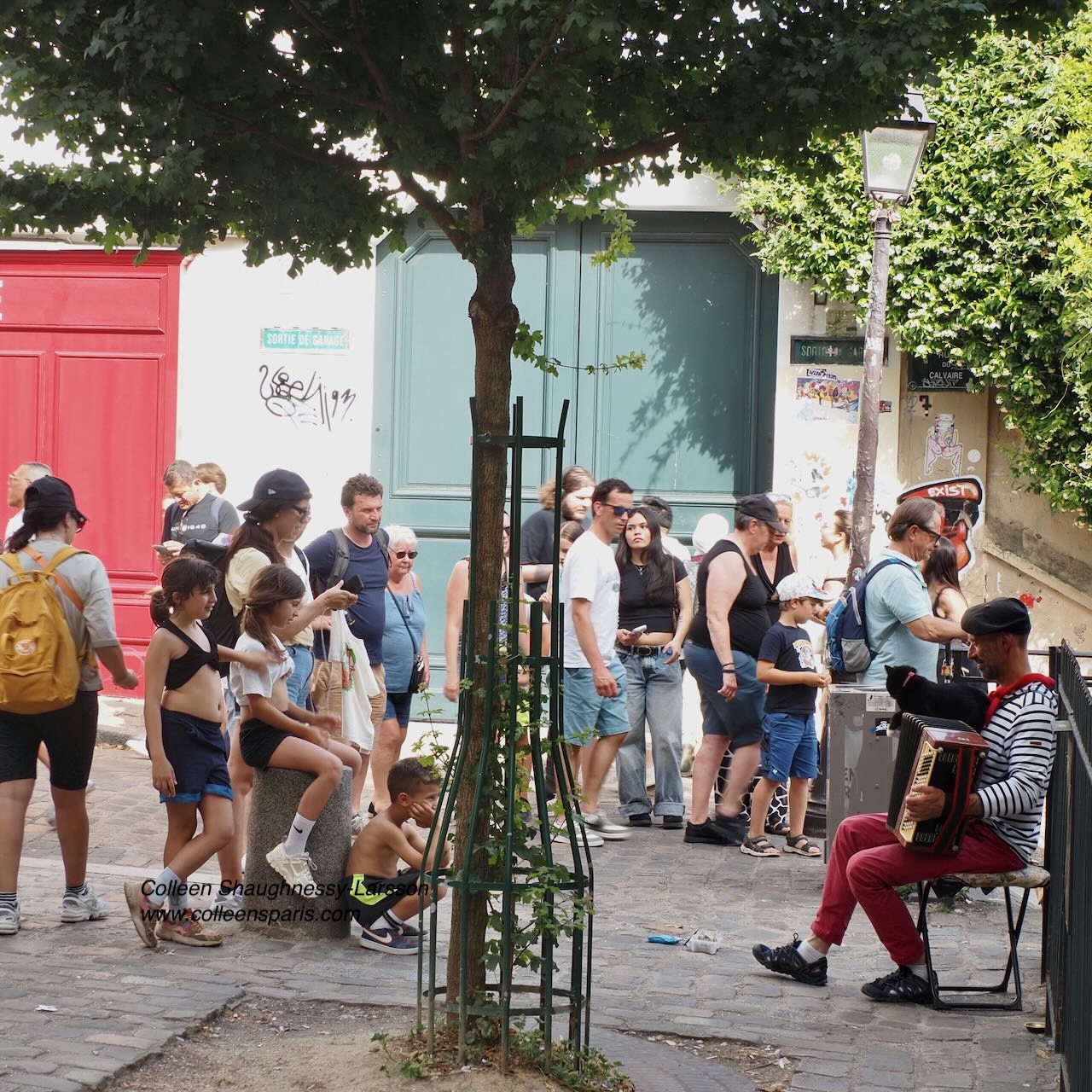
The Accordionist on Place du Calvaire
Sitting near the stairs of Place du Calvaire was a Parisian picture-perfect scene: a musician in a beret, striped shirt, red scarf, and red trousers playing the accordion. A curious young audience had gathered, charmed either by the music or by the cat calmly perched on top of his accordion.

Look Up, Look Around: Street Art & PSG Fans
Heading into the final stretch of our walk, Montmartre’s street art was once again on full display. Swiss artist Thomas Vuille’s iconic yellow “M.Chat” with wings grinned down from a wall on rue Drevet. Further along rue Gabrielle, a peeling paper illustration titled “Paris Spirestar” by Samt (Sam) Kerridge caught my eye just above a man peering into a ground-floor window.
In front of me, a pair of Paris Saint-Germain (PSG) fans were draped in team colors. That night, May 30, PSG would beat Arsenal to become the winners of the 2025–26 Champions League final in football (soccer) in Budapest, Hungary.


Rue Foyatier
We wrapped up our afternoon with some people-watching and street-style photography (sometimes there is no time for focus!) along rue Foyatier before saying our goodbyes.


My Take on the Photo Walk
I can recommend “Balade Photo Montmartre” for its ease of walking and stair climbing, casual atmosphere and seeing Montmartre from a learning perspective. The three-hour scheduled tour began at 2:30 p.m. but lasted closer to three and a half hours. The tour is in French and cost 69 Euros. The photo tour with Raphaël Blasselle left me and the others wanting more, except it was getting late. I chose Graine de photographe because I have attended one of their workshops in the past. It was the perfect ending to a day spent uncovering the hidden angles, lively characters, and quiet (if you avoid the crowds) magic of Montmartre.